
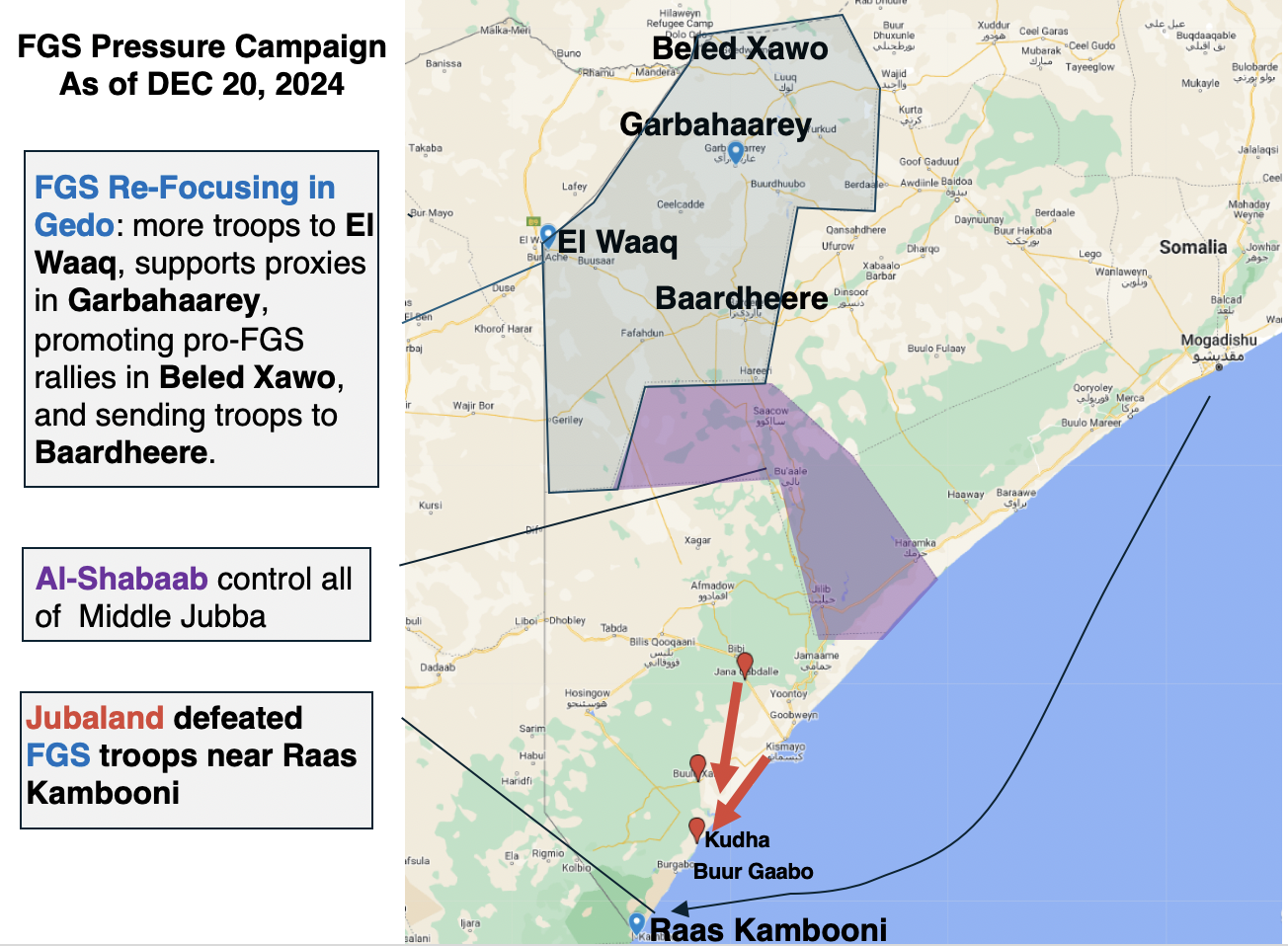
The question of the week: how would the Federal Government of Somalia (FGS) respond to its embarassing defeat to Jubaland forces in Lower Jubba and continue efforts to isolate regional president Ahmed Madobe? The answer: By augmenting efforts in Gedo region, where there is a weaker concentration of Madobe’s troops and long-running angst against the regional leader.
- The FGS is flying more troops in to Baardheere as part of plans to increase its force projection in the area, according to Shabelle media. It also appears to be orchestrating pro-FGS protests in Beled Xawo.
- This week, Madobe fired the pro-FGS governor of Gedo, Abdullahi Jama “Shimbir”, and replaced him with Mohamed Hussein Isaaq “al Qaadi”…
- …However, the FGS sent the Minister of Security to Garbahaarey in a sign that it will continue to provide support to its proxies and associated militias.
- On December 19, the Somalia Civil Aviation Authority reportedly foiled an attempt by Ethiopia to send a plane full of weapons from Doolow to Madobe’s forces in Kismaayo, according to Radio Kulmiye. Authorities were suspicious of the flight and instructed it to land in Mogadishu first for inspection. The plane ended up returning to Doolow.
What to Watch for:
- Ethiopia returns to business as usual: Ethiopian troops have the opportunity to continue its alliance with Jubaland and can serve as a counter balance to the FGS in Gedo. Due to the Ankara Agreement, the FGS likely will not have the leverage to threaten the eviction of Ethiopian troops in the short-term.
- FGS conducts electoral planning to “chip away” Madobe’s legitimacy: There is almost no scenario in which Madobe resigns his position or agrees to an FGS-managed direct election. As a result, watch out for the FGS to socialize direct elections or carry out voter registration in areas of Gedo it controls. While high profile political activities in Gedo would contest Madobe’s political authority, they would also escalate tensions in the same way that led to fighting in Raas Kambooni.
News in Brief — Here’s are some other articles of note this week:
“Sudan is caught in a web of external interference. So why is an international response still lacking?” Emadeddin Badi dives into the web of alliances in the war between the Sudanese Armed Forces and the Rapid Support Forces, inflamed by interests in gold, port access, and global spheres of influence.
Will Somalia’s next peacekeeping mission have a predictable and sustainable funding mechanism? Amani Africa expertly explains the six options for funding the African Union Support and Stabilization Mission in Somalia (AUSSOM). Deploying AUSSOM may be delayed due to the disagreement over funding, which would require an extension of the current ATMIS mission seeking to close by 2025.
“This is what democracy looks like”…International Crisis Group has an excellent report on the Somaliland election. And, after holding direct elections in 33 districts since 2021, Puntland continues genuine efforts to decentralize governance to the district level through convening all stakeholders at the table. This shows that the FGS has a blueprint for universal suffrage — but it has not chosen to implement it.
Discover more from
Subscribe to get the latest posts sent to your email.
Categories: Around the Horn
Related Articles
-
 Around the Horn: Somalia’s Coronavirus Cases Now Among Highest in East Africa
-
 Somalia Gets Ventilators, Kenya Mass Tests in Poor Areas, and More East Africa Updates
-
 Unexplained Deaths in Tanzania, Somalia’s Coronavirus Data Gaffe, and more East Africa Updates
-
 East Africa Coronavirus Roundup: April 30, 2020
 somalianewsroom.com
Leave a comment